Why do we need signal transduction?
As most things that affect cell activity or function do not enter cells Instead they act on membrane-bound receptors that control signalling proteins via the production of secondary messengers
What is the function of secondary messengers ?
They mediate cell activity (including gene expression)
What are the 2 ways that a signal can be transduced ?
1). Via proteins inside the cell which can change its behaviour (fast response - Seconds to Minutes) 2). Via making new proteins by transcription in order to change a cells behaviour (Slow - Minutes to Hours)
How do signalling proteins generally act ?
Many signalling proteins act as molecular switches
How many kinases and phosphates does the human genome encode?
Approx 520 kinases and Approx 150 phosphates
What are the two common pathways used to activate/deactivate signalling proteins ?
1). Signalling via phosphorylation; - The signal goes into the cell via the receptor and activates protein kinase which coverts ATP to ADP and adds a phosphate onto the target protein to activate it - The phosphate is cleaved off the activated protein using protein phosphatase and this releases phosphate so it can bind back onto ADP to form ATP and the protein is deactivated 1). Signalling via GTP binding; - The signal goes into the cell via the receptor and activates GTP binding which coverts GDP to GTP which binds onto the target protein to activate it - The GTP is attached to the activated protein is hydrolysed using GTP hydrolysis which releases a phosphate, consequently leaving GDP binded to the protein and the protein is deactivated
What are the two main types of kinases ?
Tyrosine kinase and Serine/Threonine kinase
What are the two main types of GTP-binding proteins ?
Trimeric G proteins and Monomeric GTPases
What does ligand binding do ?
- Ligand binding activates a G-protein which in turn activates or inhibits another protein, which is often an enzyme which generates a specific second messenger
What does GPCR’s stand for?
G-protein coupled receptors
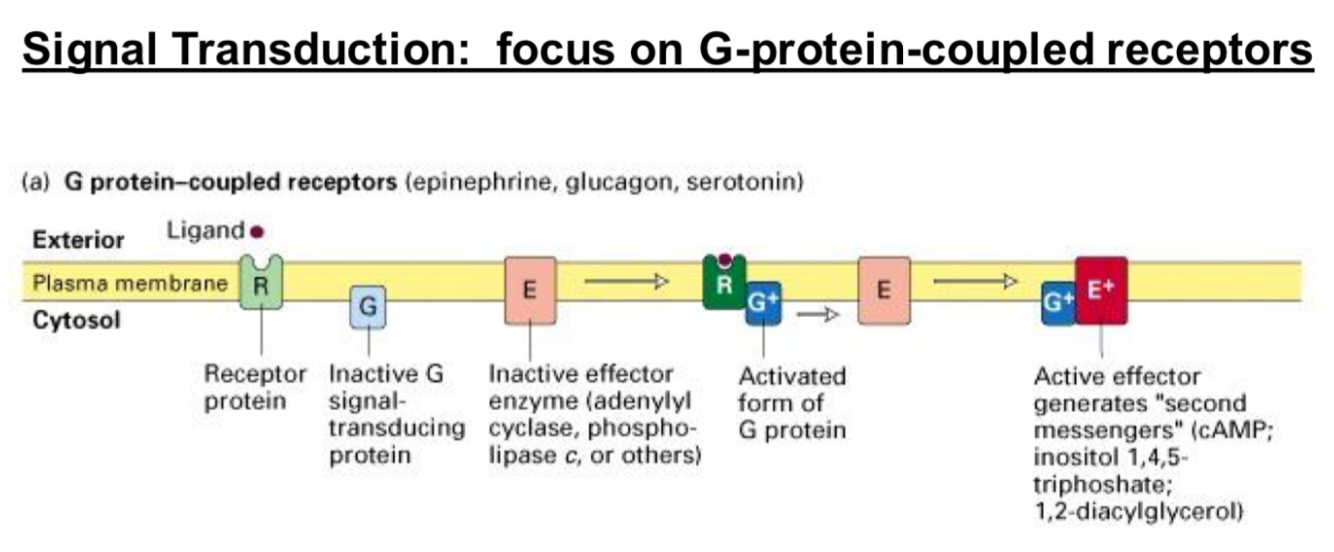
What series of steps occurs when activating G-protein-coupled receptors?
- An extracellular ligand binds to then G-protein-coupled receptor protein found in the plasma membrane
- This activates the inactive G-signal transducing protein (this is known as the G-protein activation) which inhibits/activates a down stream inactivated effector enzyme
- An inactivated effector enzyme (like adenylyl cyclase or phospholipase c) binds onto the now activated form of G-protein (this is known as complex formation)
- The Active effector (G-protein + Enzyme) generates “second messengers” (like cAMP; inositol 1,4,5-triphosphate; 1,2 - diacylglycerol)
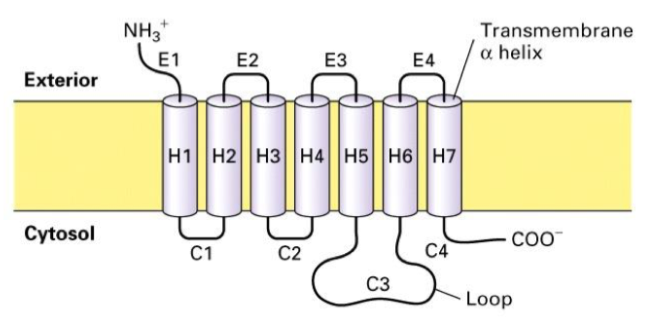
What do all G-protein-coupled receptors have?
7 membrane spanning regions; - with their amino termini (N-terminus) facing extracellularly - with their carboxyl termini (C-terminus) facing intracellularly from the plasma membrane
How can many of the cell-surface receptors be described?
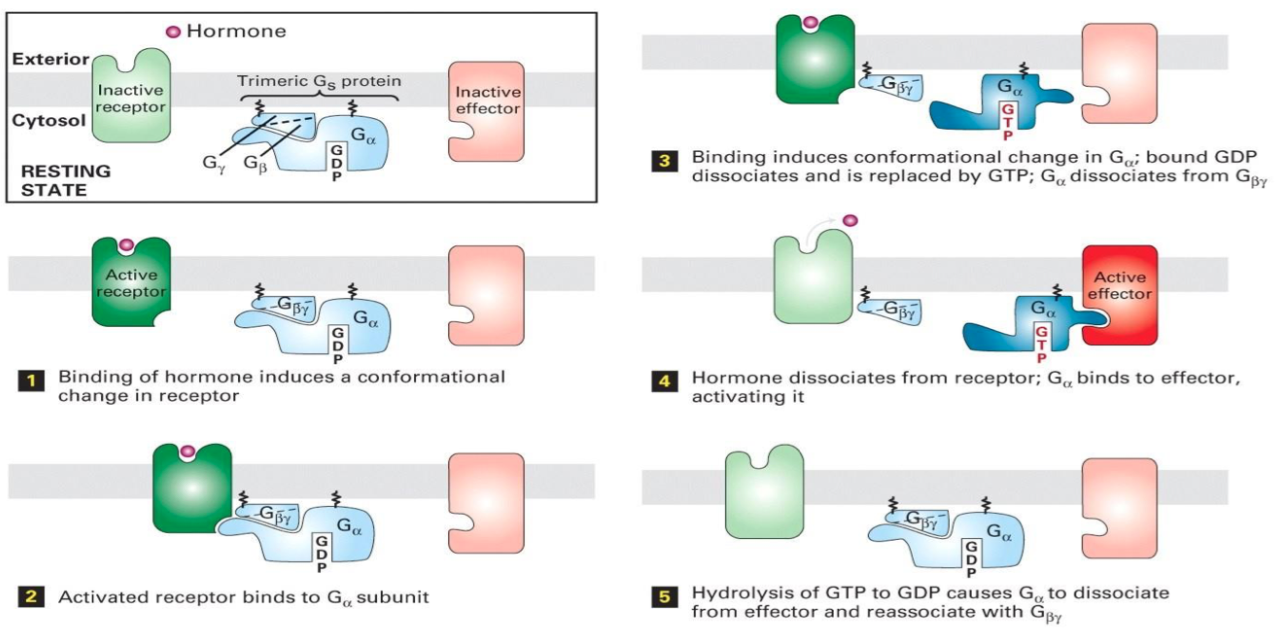
Many of the cell-surface receptors are coupled to trimeric signal-transducing proteins (composed of three different subunits - Alpha, Beta and Gamma) that bind to either GTP or GDP
Describe the mechanisms of action of G-protein signal transduction?
- The ligand binds to the receptor and changes its conformation, causing the receptor to bind to the G-alpha (Ga) protein, during this GDP is displaced by GTP which binds to the G-alpha (Ga) protein
- This triggers G-Beta-Gamma (GBy) to release from the Gs trimeric protein (Containing G-alpha protein and G-Beta-Gamma protein joined together)
- This release of G-Beta-Gamma (GBy) activates downstream pathways
- These pathways only last for a short period of time as GTP which is bonded to G-alpha hydrolyses back to GDP in seconds, causing G-Beta-Gamma (GBy) to bind back onto G-alpha and the inactivation of the enzyme adenylate cyclase
What is GTP required for?
GTP is required for the ligand-induced stimulation of Adenylate Cyclase (enzyme)
What couples to G-alpha ?
Glucagon
What are the 3 things that is required for a signal transduction system?
1). A receptor (e.g - Glucagon) 2). A transducer (G-protein) 3). An amplifier (adenylate cyclase) which generates a large amount of second messenger
What is the role of Adenylate cyclase ?
Amplifies signals and produces large amounts of second messengers
What is the structure of G-protein-coupled receptors (GPCR) ?
Their receptors consists of 7 transmembrane helices (hydrophobic amino acids) which sit in the plasma membrane - which are Beta helices (called Beta 2 adrenergic receptor) They interact with heterotrimeric G-protein complex on the extracellular side (has Alpha, Beta and Gamma subunits)
How many types of G-alpha subunits is there?
20
What are the 3 main types of G-alpha classes and their functions?
Gaq (or Gq) - Stimulates phospholipase C Gs - Stimulates adenylate cyclase, increases cAMP Gi - Inhibits adenylate cyclase, decreases cAMP
What is unique about all GPCR’s (G-protein-coupled receptors) ?
All GPCR’s exhibit preferential association with a particular G-protein (or subset of G-protein) GCPRs signal via GTP-mediated activation of G proteins
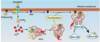
How do GPCR’s signal and draw a diagram ?
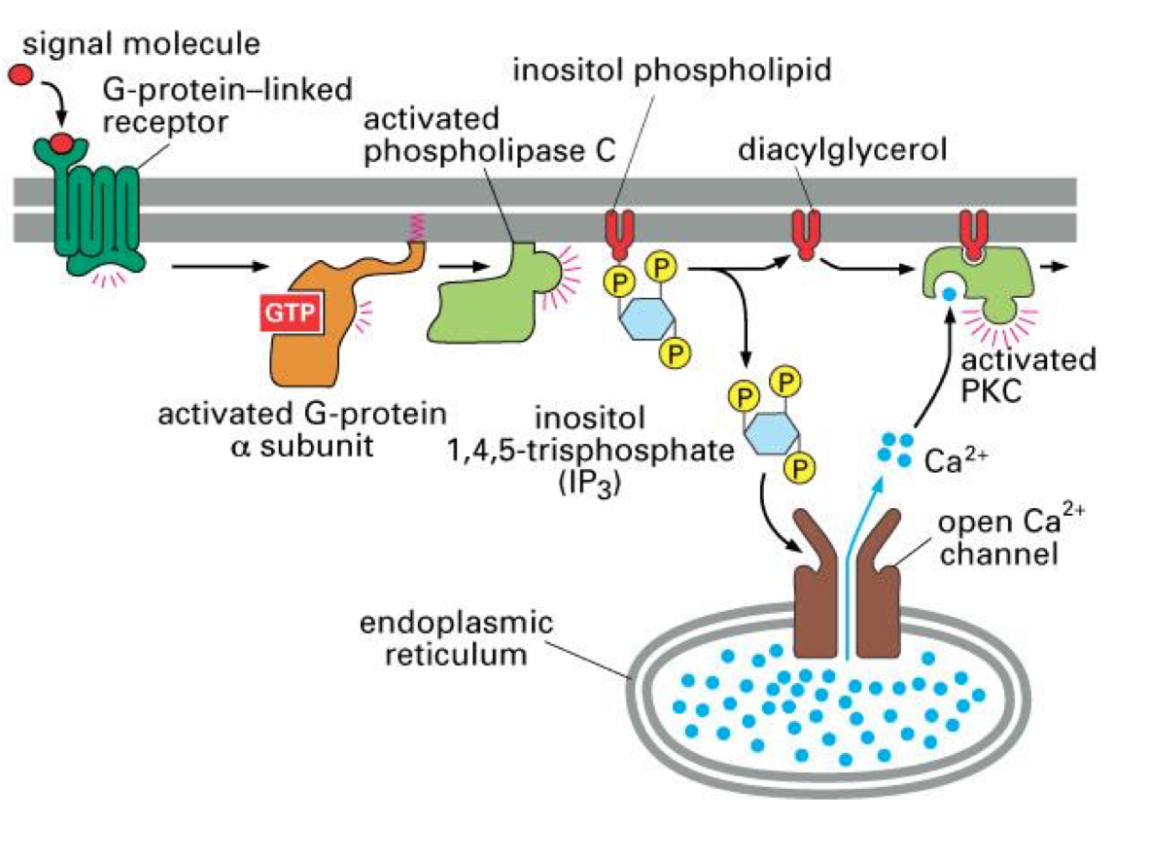
- A signalling molecule activates a G-protein linked receptor which activates a G-protein subunit
- This activates the enzyme phospholipase C which liberates two signalling molecules from Phosphatidylinositol 4,5-biphosphate (PIP2), a phospholipid found in the lipid bilayer
- This creates inositol 1,4,5 triphosphate (IP3) and diacyglycerol (DAG)
- The inositol 1,4,5 triphosphate (IP3) activates the Calcium channel on the endoplasmic reticulum causing a calcium influx inside the cell to activate PKC (Protein kinase C) and the binding of the diacyglycerol (DAG) also further activates the Protein kinase C (both substances are required to activate it)
What are phospholipase C isoforms ?
Phospholipase C isoforms are proteins which possess distinct domain structures but catalyse the same reaction (releasing of IP3 and DAG from PIP2) Some domains are common (catalytic, membrane localisation) and some are unique (regulatory)


-
Introduction to the limbs94
-
Osteology and circulation of the upper limb131
-
Skeletal and Cardiac Muscle39
-
Sarcomere Structure43
-
Upper Limb: Blood supply and Lymphatics20
-
Upper Limb: Bones and Joints40
-
Upper Limb: Forearm Muscle attachments18
-
Excitation Contraction Coupling in Cardiac and Skeletal Muscle40
-
Upper Limb: Nerves18
-
Force generation, energy usage and fibre types29
-
Smooth muscle contraction31
-
Upper Limb: Pectoral and Scapular Regions35
-
Spinal Nerve Supply for Movements15
-
Lab - Biological Sample Analysis5
-
Clinical - GALS8
-
Introduction to Metabolism38
-
Glycolysis32
-
Pharmacology of the Neuromuscular junction34
-
Upper Limb: Arm and Forearm26
-
Citric acid cycle25
-
Sensory receptors49
-
Upper Limb: Hand and Wrist33
-
Metabolic Stores COPY36
-
Metabolic Stores COPY COPY27
-
LAB - Muscle Contaction6
-
Lipids in cell membranes 238
-
Lab - Muscle contraction3
-
Teamwork, Communication and Patient safety14
-
The Use of Medicines41
-
Metabolic Changes in Health and Disease44
-
Neurological Exam Upper Limb52
-
Ethics at the beginning of life37
-
Applied Anatomy of the Limbs12
-
Signal Transduction55
-
Reflexes COPY60
-
Atherosclerosis19
-
Cholesterol Lowering Drugs COPY35
-
Structure of the Autonomic NS64
-
Autonomic Nervous System 133
-
Ethics of End of Life21
-
Autonomic NS 223
-
Innate Immunity COPY66
-
Blood Coagulation19
-
Guided Study: BMA and Assisted Suicide3
-
Guided Study : Destined to Die1
-
Drug Receptor Interactions59
-
Autonomic NS 339
-
Ascending Neural Pathways47
-
Thrombosis, Embolism, and Infarction66
-
Antibodies36
-
Descending Motor Pathways39
-
Drug Receptor Interactions 216
-
Drugs affecting haemostasis and thrombosis14
-
Anticoagulant Drugs51
-
Haematopathology: Anaemias and Leukemias40
-
Haematopoiesis and Anaemia19
-
Bone and Joints of the Lower Limb32
-
Circulation and Lymphatics of the Lower Limb24
-
Nerves of the Lower Limbs57
-
Nerves of the Lower Limb29
-
Gluteal Region and Thigh37
-
Guided Study: Data Interpretation: Full Blood Count8
-
Bone and Joint Infections39
-
Cell Death38
-
Impact of Life Events on Patient Well-Being20
-
Blood Groups23
-
Cell Division43
-
B and T cells and MHC13
-
T and B cells, cytokines and dendritic cells25
-
Stress16
-
Meiosis29
-
Blood Supply of Limbs83
-
Brachial and Lumbo-Sacral Plexuses60
-
Glenohumeral and Hip Joints151
-
Pectoral and Pelvic Girdles53
-
Elbow and Knee Joints87
-
Wrist, Hand, Ankle and Foot82
-
Palm of Hand and Sole of Foot57
-
Labs19
-
Guided Studies16
-
Clinical Skills Yellow Questions14
-
The Leg32
-
The Foot30
-
Pharmacokinetics 124
-
Screening33
-
Epigenetics18
-
Pharmacokinetics 221
-
Epidemiology: Key concepts25
-
Mendelian Inheritance of Human Disease37
-
Disorders of Growth and Differentiation38
-
Chromosomes and Chromosomal Abnormalities28
-
Carcinogenesis33
-
Genetic Basis of Multifactorial disease25
-
Coping18
-
Tumour Pathology44
-
Molecular Pathology of Tumours27
-
Cancer Chemotherapy42
-
NSAIDs28
-
Molecular Patterning During Development31
-
Bone Growth and Fractures32
-
Increasing Physical Activity21
-
Osteoporosis42
-
Bloodborne Pathogens (old)40
-
Sepsis32
-
Clinical Anatomy of the Lower Limb7
-
Alcohol and Health of the Nation3
-
Health and Homelessness16
-
Skin and Soft Tissue Infections14
-
Disability37
-
Bloodborne Pathogens (new)38
-
Gait40


