Which organ is most commonly transplanted?
- Kidneys
- Followed by Liver
What is the average half-life of a transplanted kidney?
12 years
What are the three phases of an immune response to a graft?
- Phase 1: recognition of foreign antigens
- Phase 2: activation of antigen-specific lymphocytes
- Phase 3: effect phase of graft rejection
What are the most relevant cellular proteins that can determine compatibility?
ABO
HLA
Which chromosome is HLA encoded on?
Chromosome 6
What are the two major components of rejection?
- T cell-mediated rejection
- Antibody-mediated rejection
Describe the basic structure of HLA Class I and Class II.
- Class I: have three alpha domains and a beta-2 microglobulin domain, has one transmembrane domain
- Class II: has two alpha and two beta domains, had two transmembrane domains
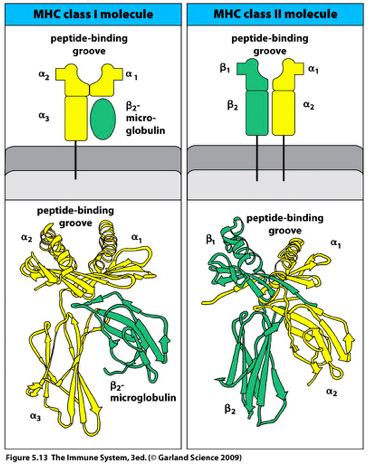
Which alleles encode HLA Class I and Class II?
- Class I: A, B and C
- Class II: DP, DQ, DR
Where are HLA Class I and Class II expressed?
- Class I: all cells
- Class II: antigen-presenting cells (can be upregulated at times of stress)
What is the benefit of having high variability in the peptide-binding groove of MHC?
Can present a wide variety of antigens
What is the disadvantage of the variability in the peptide-binding groove of MHC with regards to transplants?
This means that the host immune system can react with the slightly different MHC of the donor leading to rejection.
Which HLA alleles are most immunogenic?
A, B and DR
Where do the antigen-presenting cells that interact with host T cells come from?
From the recipient and the donor (the donor organ will contain many APCs)
NOTE: a lot of these interactions will happen in lymph nodes
Which test is used to give a definitive diagnosis of graft rejection?
Biopsy
Describe the effector phase of T-cell mediated graft rejection.
- T cells tether, roll and arrest on the endothelial cell surface
- They will migrate across into the interstitium and start attacking the tubular epithelium
- Macrophages (recruited by T cells) may also be seen in the interstitium
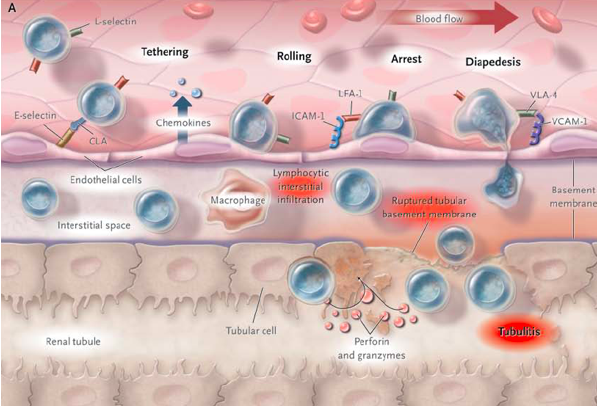
What are the typical histological features of T-cell mediated rejection?
- Lymphocytic interstitial infiltration
- Ruptured tubular basement membrane
- Tubulitis (inflammatory cells within the tubular epithelium)
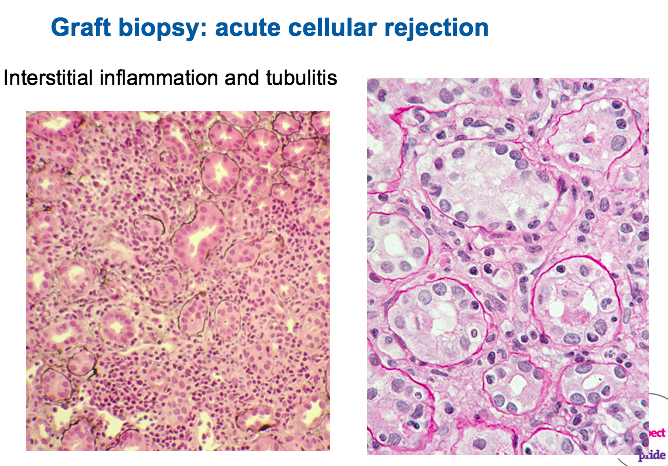
What other explanation might there be for graft failure other than rejection?
Immunosuppressive drugs may be nephrotoxic
What are the three phases of antibody-mediated rejection?
- Phase 1: eposure to foreign antigen
- Phase 2: proliferation and maturation of B cells with antibody production
- Phase 3: effector phase - antibodies bind to graft endothelium
What is a key difference between the production of anti-AB and anti-HLA antibodies?
- Anti-AB antibodies are naturally occuring (pre-formed)
- Anti-HLA antibodies are not naturally occuring but can be pre-formed due to previous exposure to epitopes (e.g. previous transplant, pregnancy) or post-formed (after transplantation)
Outline the pathophysiology of antibody-mediated transplant rejection.
- Antibodies bind to HLA on the endothelium of blood vessels within the transplanted organ
- The antibodies fix complement which leads to formation of MAC and endothelial cell lysis
- Binding of complement also recruits inflammatory cells
- This leads to inflammation of the microcirculation (capillaritis)
- This leads to procoagulant tendencies and closure of the microcirculation leading to graft fibrosis
- Antibodies can also cross-link MHC molecules and activate them
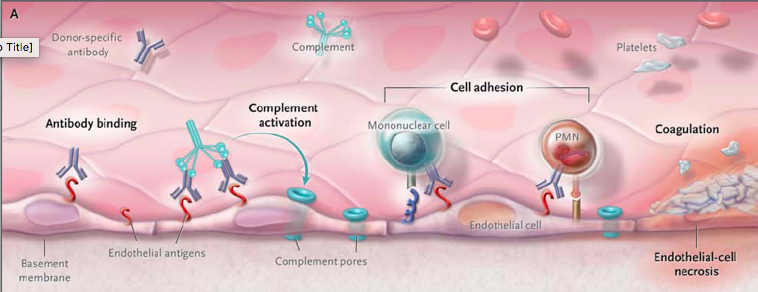
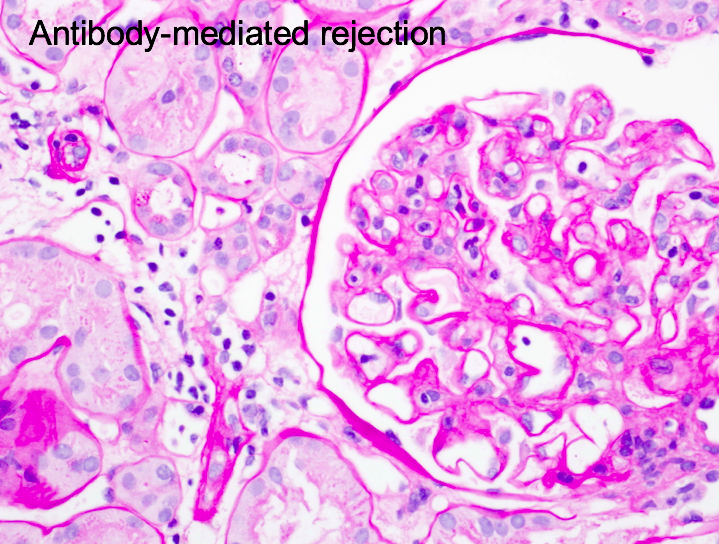
What are the main histological features of antibody-mediated transplant rejection?
- Presence of inflammatory cells within the capillaries of the graft (HALLMARK)
- Immunohistochemistry can show fixation of complement fragments on the endothelial cell surface
What are the three main approaches to preventing graft rejection?
- AB/HLA typing
- Screening for antibodies
- Overcoming organ mismatch tissues
Which technology is used for AB/HLA typing?
DNA sequencing using PCR
At what stages of transplantation will screening for antibodies be performed?
- Before transplantation
- At the time of transplant (once an organ has been assigned)
- After transplantation (check for new antibody formation)


-
Immuno: Immune response to infection45
-
Immuno: Primary Immune Deficiencies 134
-
Immuno: Primary Immune Deficiencies 240
-
Immuno: Autoinflammatory and Autoimmune diseases 149
-
Immuno: Autoinflammatory and Autoimmune diseases 243
-
Immuno: Immune modulating therapies 135
-
Immuno: Immune modulating therapies 249
-
Immuno: Transplantation43
-
Immuno: Case Studies in Immunology43
-
Immuno: Allergy40
-
Immuno: Malabsorption CPC33
-
IMMUNO: Secondary immune deficiencies and HIV infection52


