What are the key things that you want to do when you use ratios?
- try to use amounts that can give an insight into the business
- be consistent in the way that the ratios are calculated when comparing them between periods for a company or when comparing them for different companies.
When calculating ratios that include both balance sheet and income statement amounts, we generally use an average of beginning and ending balances for the balance sheet amount.
What is ROE (Return on Equity) & The DuPont Framework?
- Define It
- List the Formulas
- State what it means for a company. Is a higher or lower # better?
- It shows the return that a business generated during a period on the equity invested in the business by the owners of the business.
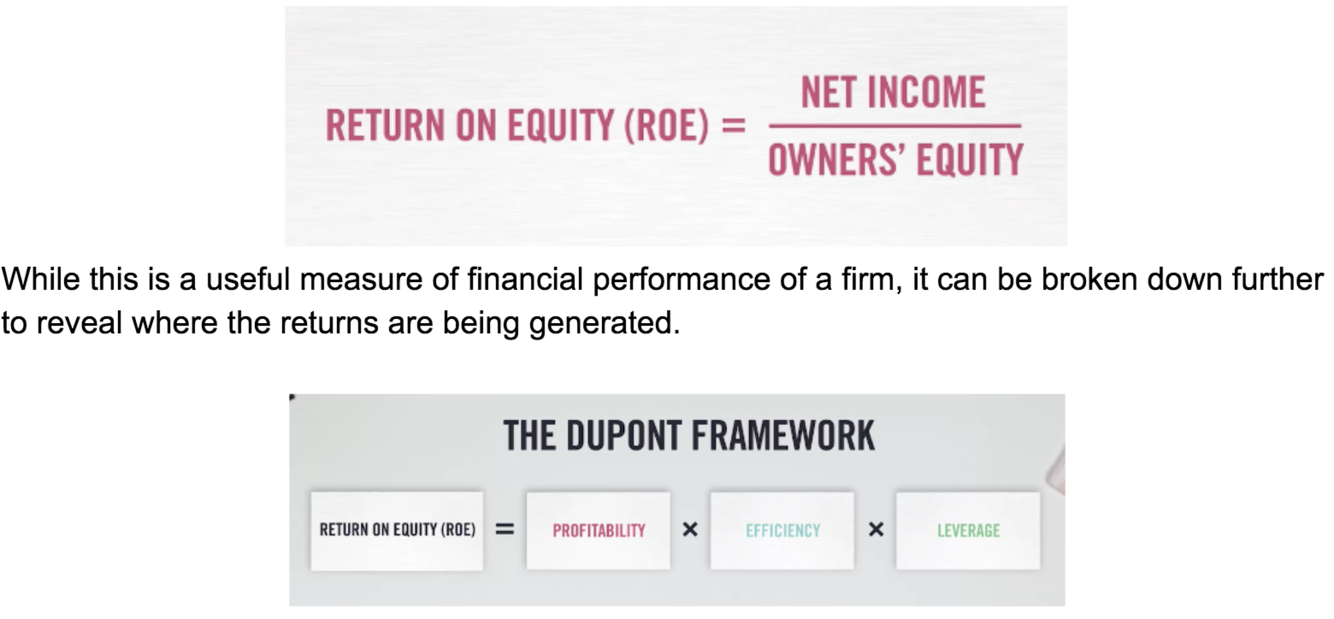
Return on equity = (net income) / (total owners’ equity)
- While this is a useful measure of financial performance of a firm, it can be broken down further to reveal where the returns are being generated. The return on equity of a firm consists of three factors: profitability, operating efficiency and financial leverage. These are three general areas that management can adjust to increase overall ROE. This breakdown, known as the DuPont Framework, allows us to see more specifically where favorable or unfavorable returns are originating.
Return on equity = profitability x operating efficiency x financial leverage
- For a profitable company, increasing the ratio in any one of these areas will increase the overall return on equity and provide greater returns for investors.
- However, if this increase is accomplished by higher leverage, the riskiness of the business increases as well. If the business makes a loss, the negative ROE is amplified by the higher leverage, making leverage a two-edged sword.*
- For any one company, a higher ROE is generally better than a lower ROE.
- However, when comparing different companies in different industries, a higher return on equity by itself does not necessarily indicate that one business is doing better than another business.*
- We end up with the same number for ROE as we do when dividing net income by equity. The only difference is that we can see more detail about what is really going on in the business and driving the return on equity. Management can use this insight to improve the way business operates.
- It’s important to keep in mind many other aspects about the business and its operations. The individual components of ROE can vary greatly between companies, depending on the type of business. For example, an online retailer might have a very low profit margin, as it fights stiff competition and doesn’t add a lot of value to the product that its purchasing from the vendor. However, a manufacturer or a technology company that uses proprietary techniques can likely demand a much higher premium for their product, which results in a higher profit margin.
What is the DuPont Framework and what does it measure?
The DuPont Framework expands the ROE formula to consist of three measures:
- profitability using Profit Margin
- efficiency using Asset Turnover
- leverage using the Leverage Ratio (or Equity Multiplier)
For any one company, a higher ROE is generally better than a lower ROE.
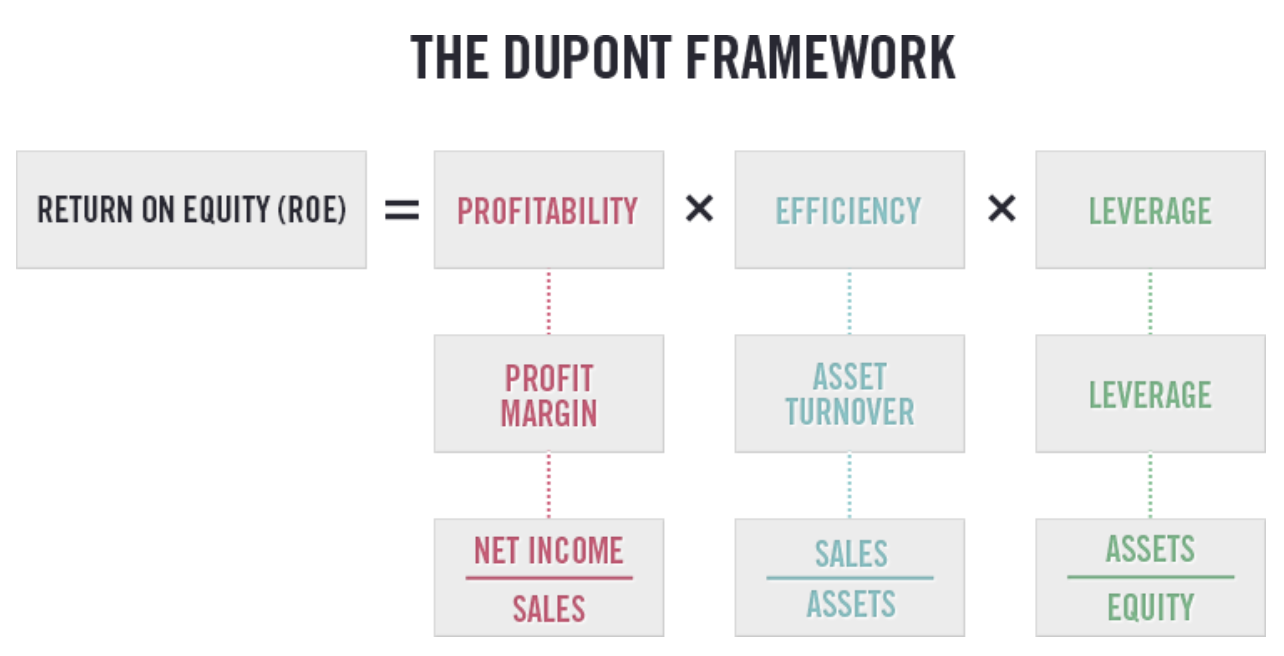
PROFIT MARGIN FORMULA
The first section of the DuPont Framework, profitability, reveals how much profit is left from each dollar of sales after all expenses have been subtracted.
- *Profit Margin = NET INCOME / TOTAL SALES FOR THE PERIOD**
- *These values are taken from the income statement*
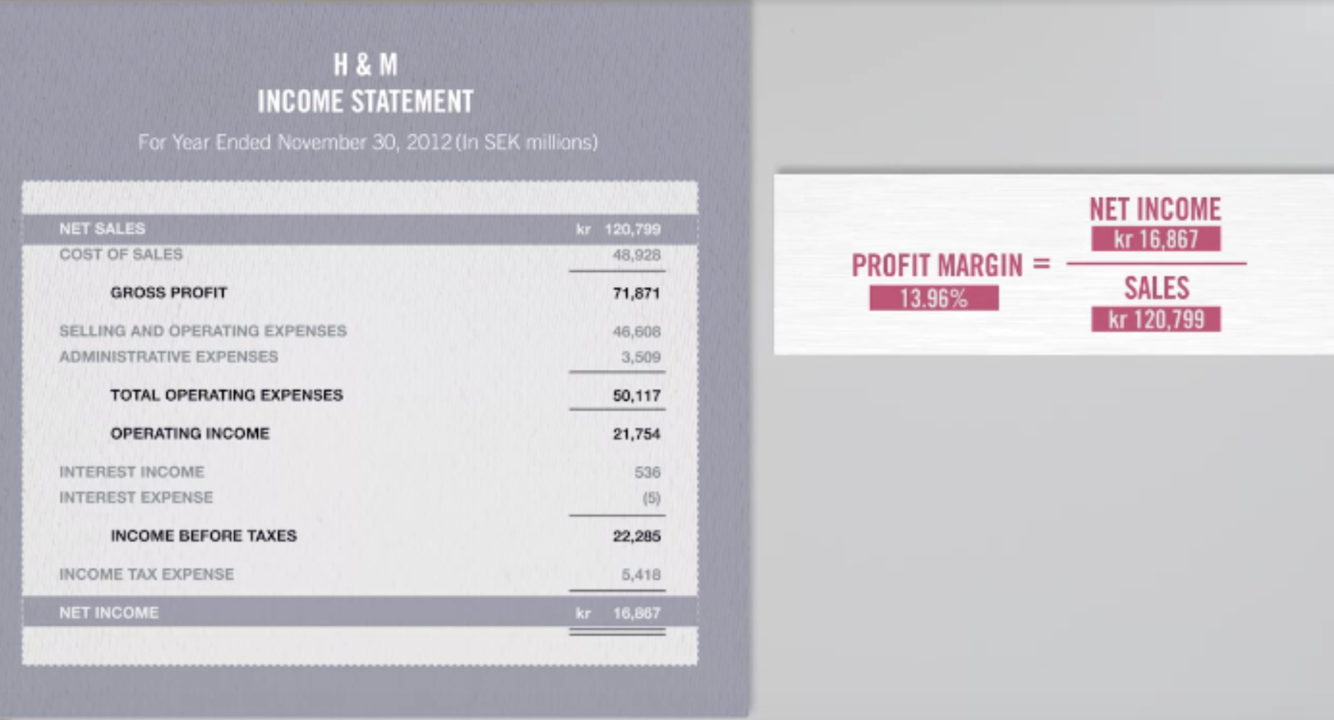
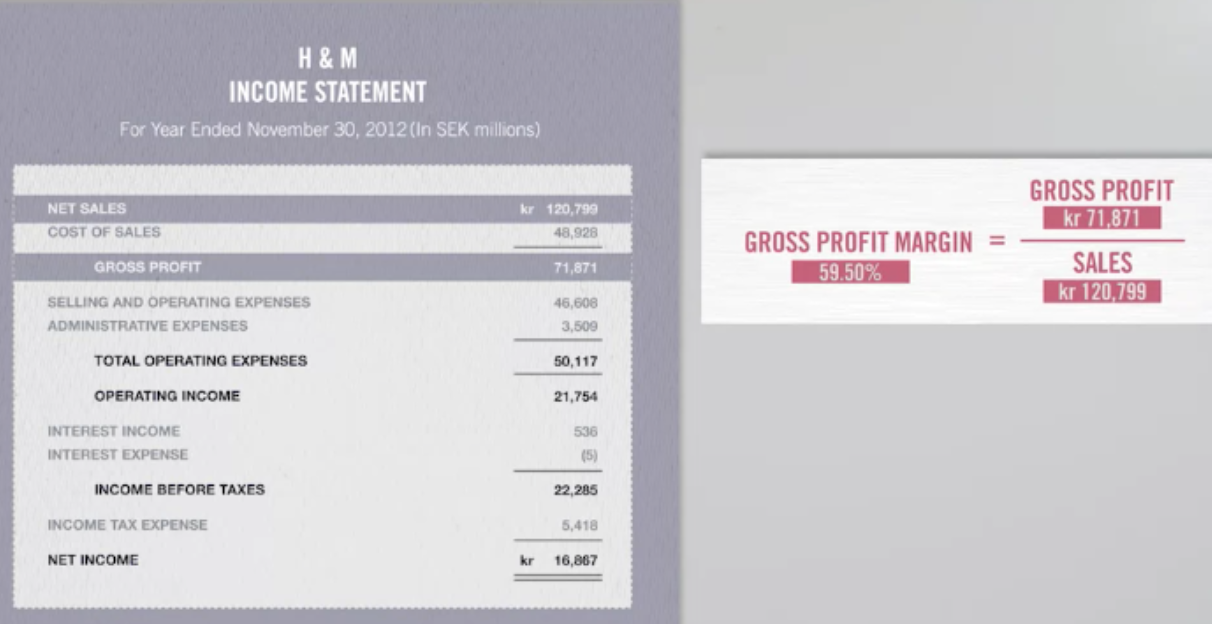
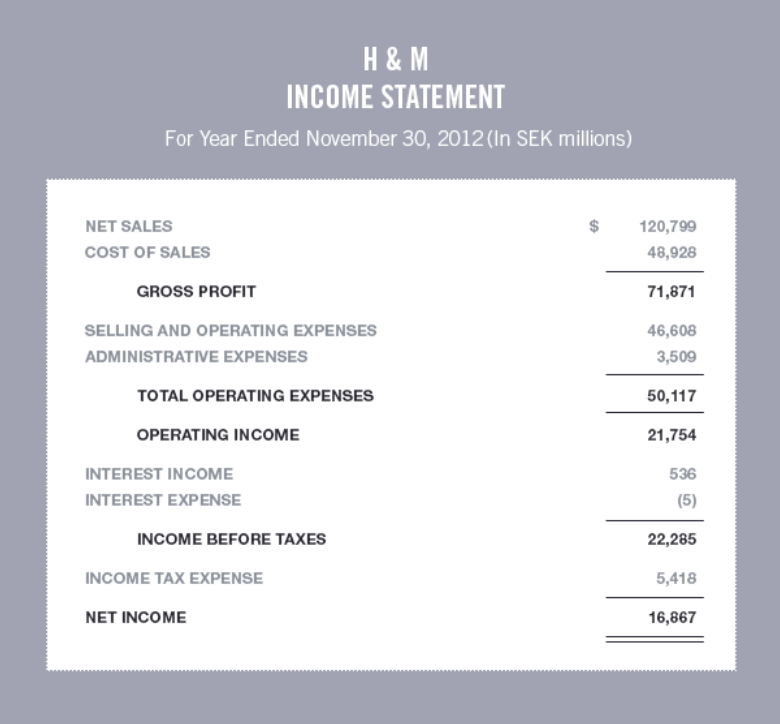
For H&M in the year 2012, the profit margin was 13.96%. In other words, for every hundred Swedish krona of sales that H&M had, 14 ended up in the net income for the period. Profit margin is an important measure.
A high net profit margin means a company keeps a large proportion of its revenue as profit, so it is better to have a high net profit margin than a low or negative net profit margin. (google)
How to do an average of 2 numbers in excel.
=AVERAGE(A1,A2) Or =SUM(A1,A2)/2 Or =(A1+A2)/2
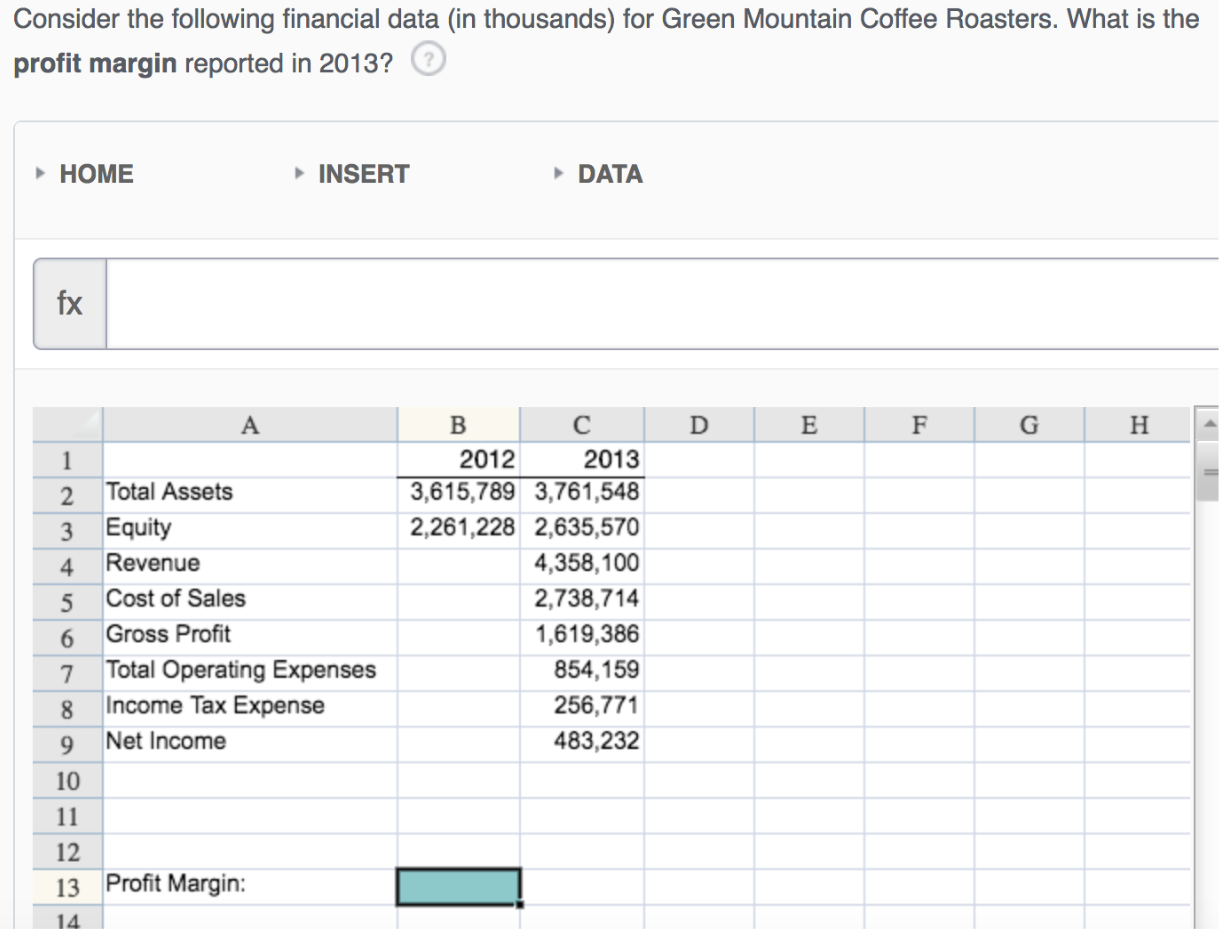
The Profitability or Profit Margin is calculated by dividing the Net Income by the Revenue. In this case, the calculation is as follows:
Net Income / Revenue = 483,232 / 4,358,100 = 11.09%
The suggested correct answer formula is:
=C9/C4
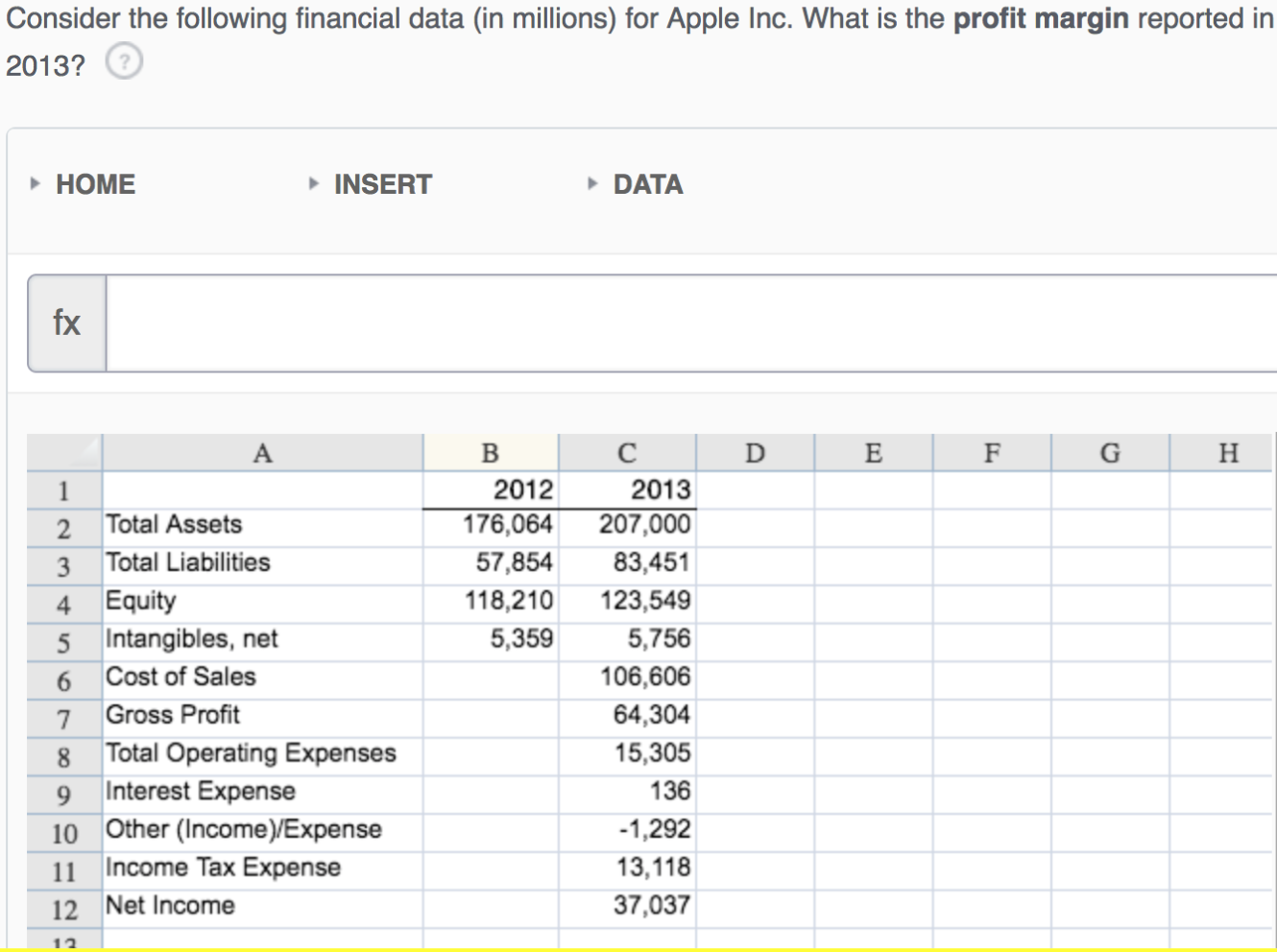
The Profitability or Profit Margin is calculated by dividing the Net Income by the Revenue. In this case, the calculation is as follows:
Net Income / Revenue = 37,037 / 170,910 = 21.67%
The trick is to recognize that the Revenue is equal to the Cost of Sales plus the Gross Profit (170,910 = 106,606 + 64,304). As we have learned, Revenue minus Cost of Sales equals Gross Profit so it follows that Cost of Sales plus Gross Profit equals Revenue.
The suggested correct answer formula is:
=C12/(C6+C7)
Which of the following ratios measures the ability of a company to make a profit relative to the revenue generated during the period?
- ROA
- Profit Margin
- ROE
- ROI
- Profit Margin
- This is the correct answer! Profit margin shows the % of each dollar of sales that ends up as net profit.
How do you calculate the profit margin ratio within the DuPont Framework?
- Operating income/Sales
- COGS/Sales
- Net income/Sales
- EBIT/Sales
- Net income/Sales
- This ratio shows the % of each dollar of sales that ends up as net profit.
Suppose the profit margin for Cardullo’s Gourmet Shoppe, Inc for Q1 was 4.99% and Q2 was 10.57%. Which of the following statements can you conclude regarding Cardullo’s?
- Cardullo’s is more efficient in utilizing its assets in Q2 than in Q1.
- Cardullo’s does a better job in cost control in Q2 than in Q1.
- Cardullo’s is more effective in extending credit and collecting debts in Q2 than in Q1.]
- Cardullo’s does a better job in cost control in Q2 than in Q1.
- This is the correct answer! Profit margin is the percentage of selling price that turned into profit. Cardullo’s could increase its profit by reducing costs, thus increase its profit margin.
The profit margin for East Corp. for each year from 2011 to 2013 is listed below.
2011: 7.13%
2012: 7.68%
2013: 8.14%
Which of the following is NOT a reasonable explanation for the trend in the ratio?
- The variable costs decreased due to an improvement in technology.
- An increase in the sales price due to higher demand resulting from a successful marketing campaign.
- East Corp. declared a cash dividend to shareholders.
- The variable costs decreased due to an improvement in technology.
- Lower variable costs would result in a higher profit margin.
- An increase in the sales price due to higher demand resulting from a successful marketing campaign.
- Increase in sales price would result in a higher profit margin.
- East Corp. declared a cash dividend to shareholders.
- This is the correct answer! This situation wouldn’t directly impact a company’s profit margin.
What is the purpose of Gross Profit Margin and what’s the formula?
Gross Profit Margin- Profitability Ratios
When the profit margin is used to determine profitability using the DuPont Framework, other ratios are also very useful. One of those is the gross profit margin. We’ve already talked about gross profit being revenues minus the cost of goods sold. This ratio is simply converting the numbers into a percentage– gross profit divided by sales. **This tells us what percentage of revenue is left to cover other expenses after the cost of goods sold is subtracted.
Gross Profit Margin = GROSS PROFIT / SALES**
*These values are taken from the income statement
What are the two Profitability Ratios?
- gross profit margin
- Earnings before interest after taxes, or EBIAT
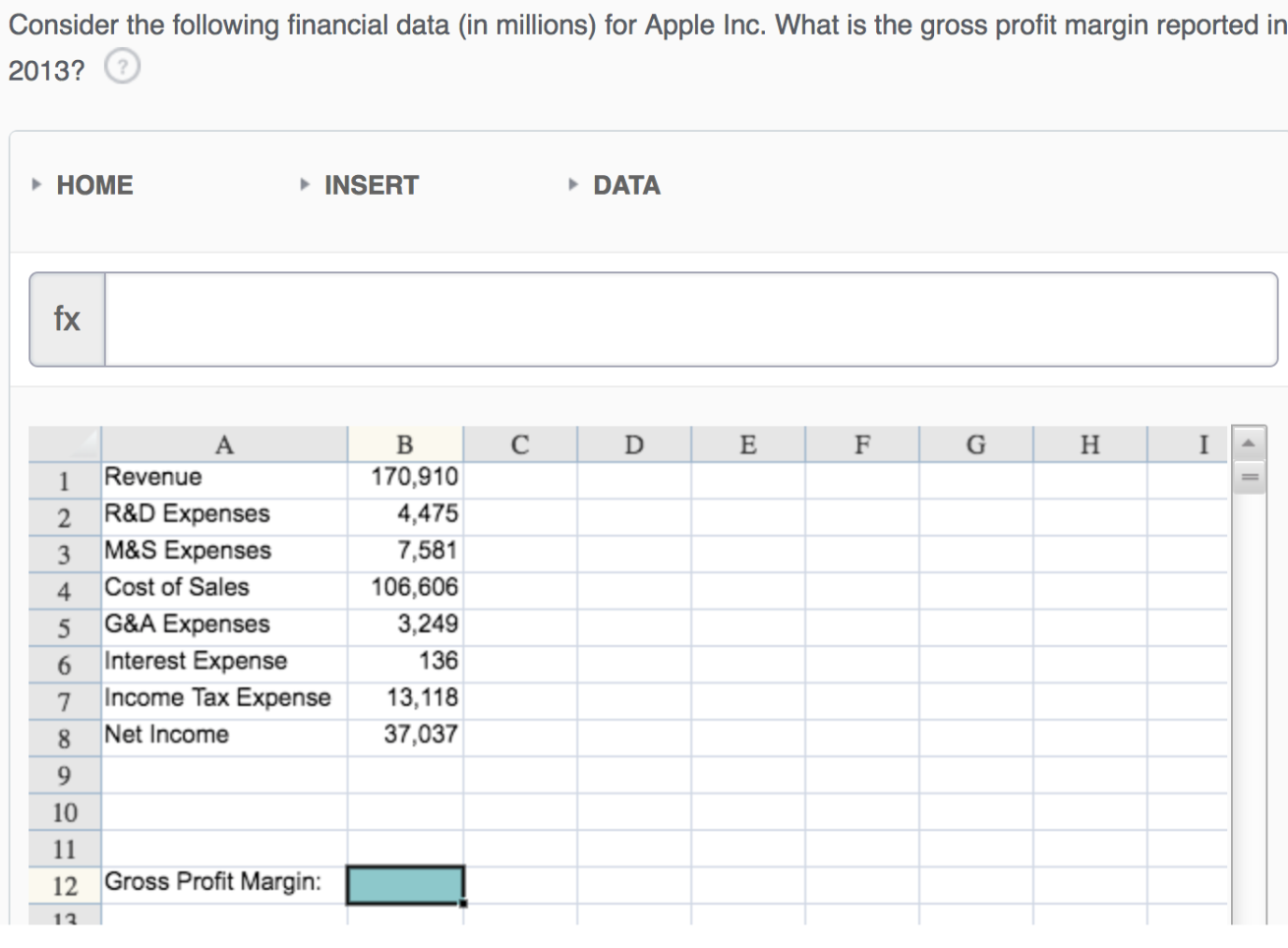
Gross Profit Margin is calculated by dividing the Gross Profit (Revenue less Cost of Sales) by the Revenue. In this case, the calculation is as follows:
(Revenue - Cost of Sales) / Revenue = Gross Profit Margin
(170,910 - 106,606) / 170,910 = 37.62%
The suggested correct answer formula is:
=(B1-B4)/B1
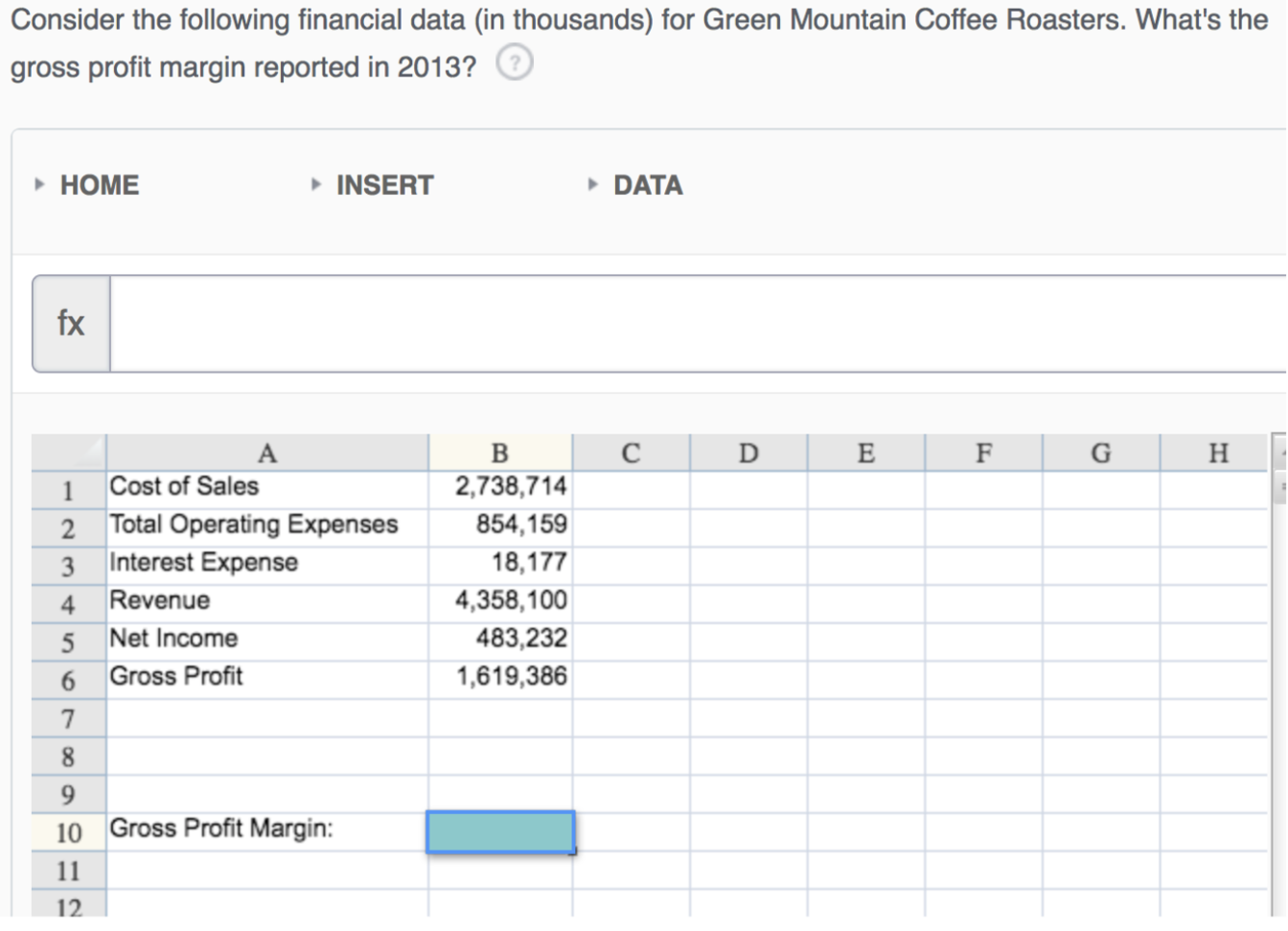
Gross Profit Margin is calculated by dividing the Gross Profit by the Revenue. In this case, the calculation is as follows:
Gross Profit / Revenue = 1,619,386 / 4,358,100 = 37.16%
The suggested correct answer formula is:
=B6/B4
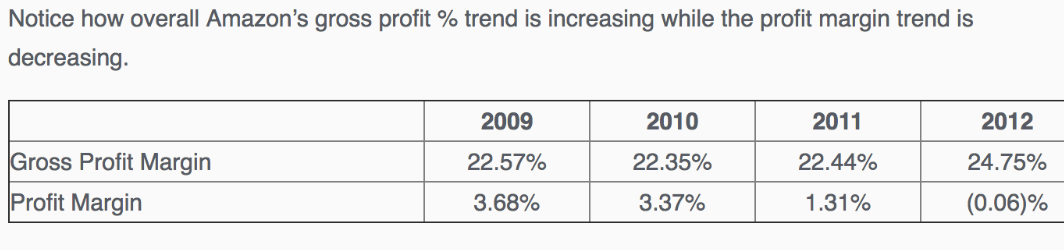
Higher demand has allowed Amazon to increase their prices, while higher overhead expenses have been hurting overall profits.
Higher selling prices would result in a higher gross profit margin, but increasing operating expenses could eat away the profits before they hit the bottom line.
The gross profit margin for Amazon for each year from 2010 to 2012 is listed below.
2010: 22.35%
2011: 22.44%
2012: 24.75%
Which explanation below is a reasonable explanation for the trend in the ratio?
- Increased competition is forcing Amazon to lower its prices.
- Amazon issued new stock during the year to raise additional capital.
- Inventory prices have fallen resulting in decreased COGS.
- Inventory prices have fallen resulting in decreased COGS.
- This is the correct answer! If the cost of inventory decreased, Amazon could make more money off of each item it sold.
Suppose the following were the gross profit margins for Green Mountain Coffee Roasters (GMCR) from 2011 through 2013.
2011: 34.13%
2012: 32.89%
2013: 37.16%
- What could be an explanation of the fluctuations in gross profit margins for GMCR from 2011 through 2013?
- Selling & Operating expenses went from 13.15% to 12.48% to 12.86% from 2011 to 2013.
- Labor and Overhead costs were lower as a percentage of Sales in 2012.
- An increase in manufacturing capacity at the beginning of 2012 caused overhead to increase but allowed for greater efficiency and significant sales growth later.
- An increase in manufacturing capacity at the beginning of 2012 caused overhead to increase but allowed for greater efficiency and significant sales growth later.
- This is the correct answer! The increase in overhead costs could hurt 2012 margins but pave the way for more profitable operations in 2013.
Suppose the gross profit margin for Cardullo’s Gourmet Shoppe, Inc for Q1 was 47.25% and Q2 was 47.70%. Which of the following is a reasonable explanation for the change in the ratio?
- Cardullo’s offered a volume discount in Q2.
- Cardullo’s negotiated with vendors and successfully reduced overall inventory prices.
- Cardullo’s sold a truck and realized a gain on the sale in Q2.\
- Cardullo’s negotiated with vendors and successfully reduced overall inventory prices.
- This is the correct answer! If the cost of inventory decreased, Cardullo’s could make more money off of each item it sold.
What is… Earnings before interest after taxes, or EBIAT?
Earnings before interest after taxes, or EBIAT, is a measure of how much income the business has generated while ignoring the effect of financing and capital structure, or the proportion of debt that the business has. As the name implies, interest expense, which is included on the income statement, is added back, and income tax expense is calculated and subtracted based on earnings before interest.
For H&M, EBIAT for 2012 is 16.8 billion Swedish krona.We will not go further into calculating EBIAT now, but it is an important measure to understand as we will see it again in Module 7.
Define & List the Formula to Asset Turnover
This tells us how well a business is using its assets to produce sales. Initially, it may seem like it is good for a business to have many assets. However, from an efficiency perspective, this isn’t the case. A business that can create more revenue with fewer assets is more efficient.
ASSET TURNOVER = SALES / ASSETS
*These values are taken from the income statement & the balance sheet
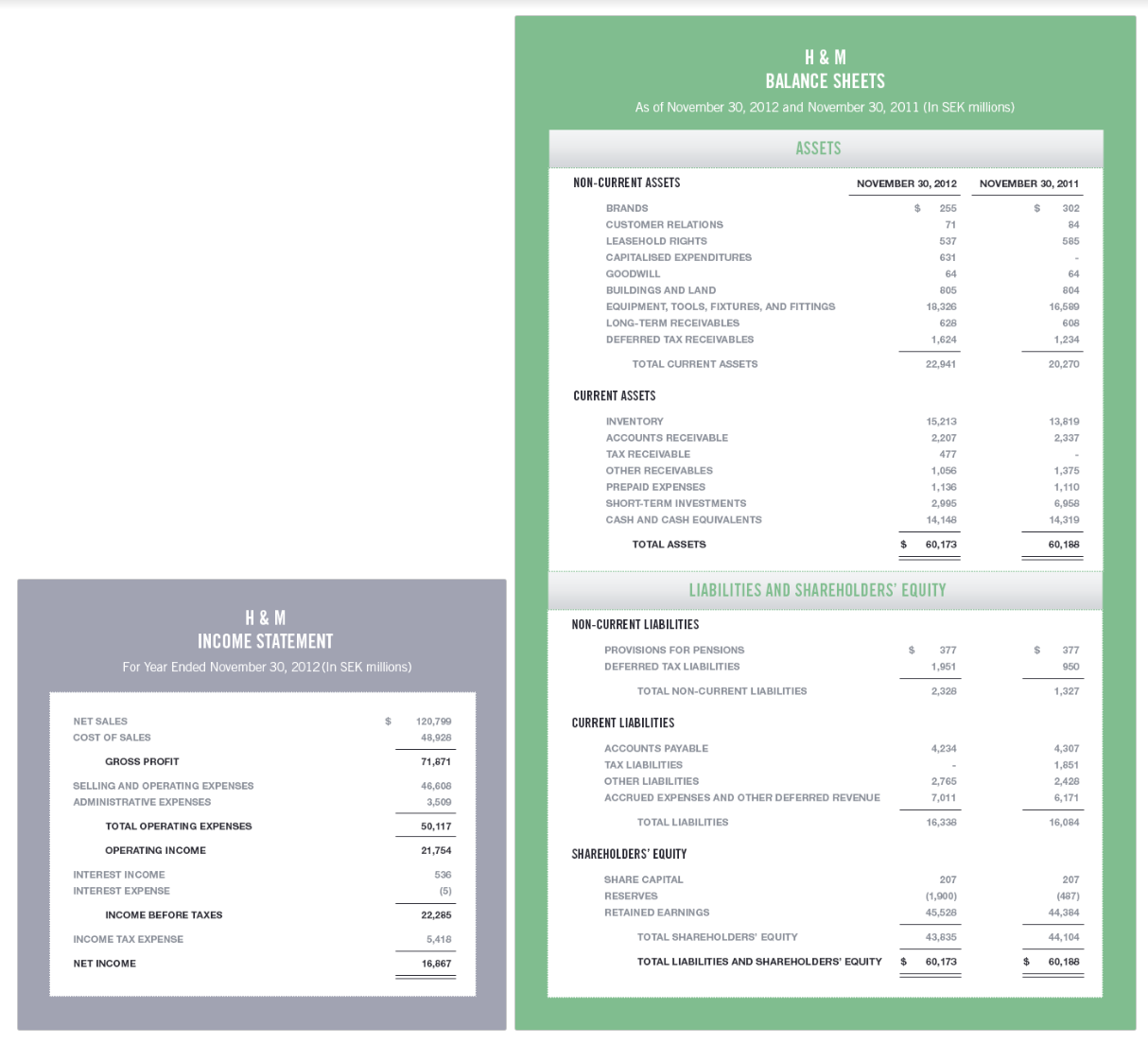
H&M’s asset turnover for 2012 was 2.01. This shows that H&M generated sales of about 2 krona on each krona of assets during the period. An interesting thing to note here is that _this ratio uses both the income statement and the balance sheet._ Because the income statement covers the entire year, but the balance sheet is as of a specific point in time, we typically use the average of the beginning and ending balance sheet amounts to estimate the average level of assets during the period.
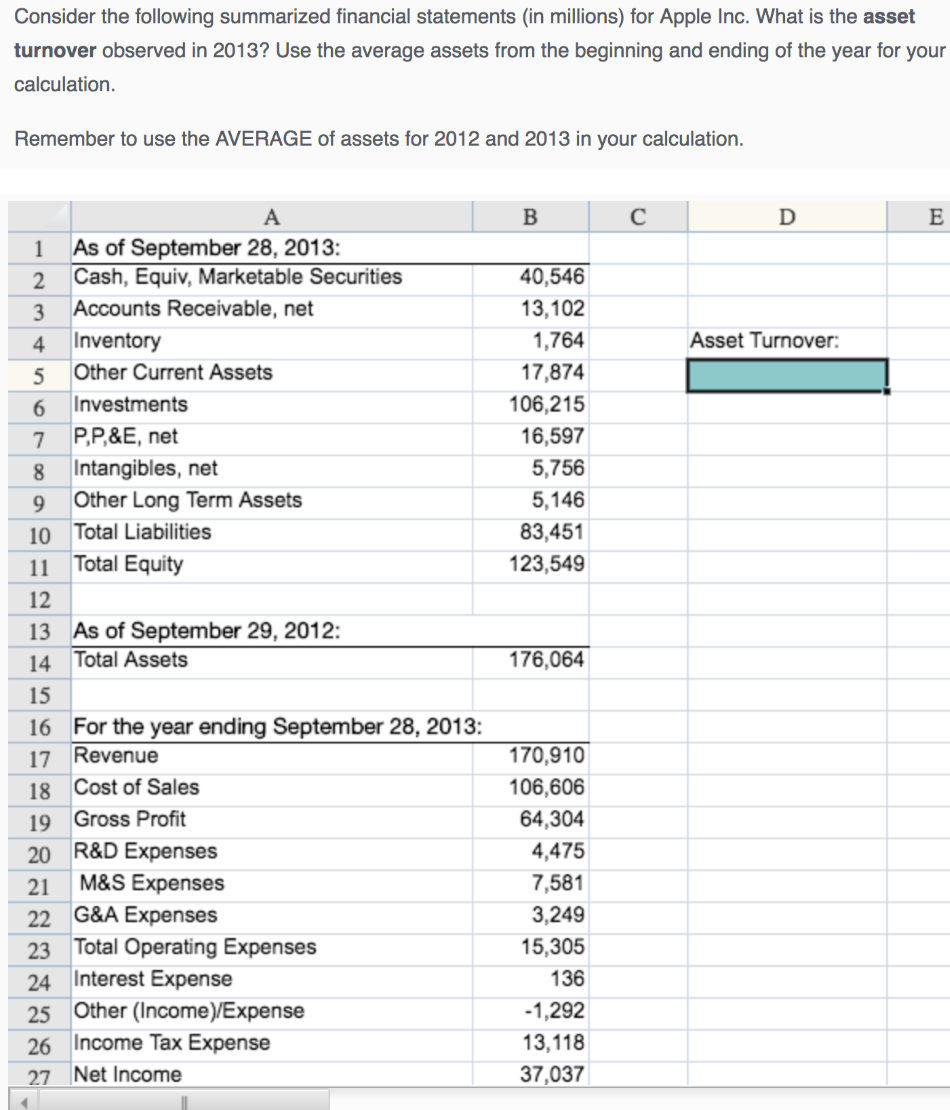
Asset Turnover is calculated by dividing the annual revenue by the average asset value for the year. In this case, we are using a two-point average of beginning and end of year asset values so the calculation is as follows:
Revenue / Average Assets = 170,910 / 191,532 = 0.89
To calculate average assets, you are given the beginning total of $176,064 but you must calculate the ending total by summing all asset accounts as of Sept 28, 2013 (a shortcut would be to add the Liabilities and Equity at September 28, 2013, since we know A = L + OE). The ending total is $207,000 making the average $191,532.
There are several formulas that could help you arrive at the correct answer, but one solution is presented below:
=B17/AVERAGE(B14,SUM(B2:B9))
Name the Different Efficiency Ratios
- Asset Turnover
- Inventory turnover
- Days Inventory
- The Accounts Receivable Turnover
- The average collection period
- Accounts Payable Turnover
- days purchases outstanding.
- Cash Conversion Cycle
- Define the purpose of the ratio for Inventory turnover,
- explain the formula, and
- state what a higher inventory represents
- This is a very useful ratio to understand how efficiently a business is managing its inventory levels. Just as more sales for a given level of assets increases efficiency, keeping less inventory on hand relative to the quantity of inventory sold does the same. Excess inventory costs money to store and uses up the firm’s cash that could be used for other investments. If a business can have lower inventory levels, while not running out of inventory for customers, it can operate more efficiently.
- INVENTORY TURNOVER = COGS/AVERAGE INVENTORY
- A higher inventory turnover represents more efficient inventory management.
Notice how again we used the average inventory balance instead of the ending balance that is typically displayed on the balance sheet. This is especially significant and provides better results than using the ending balance, especially for a firm that is growing quickly, as the level of inventory could have fluctuated during the year. We could further improve the accuracy by averaging more frequent inventory balances, such as quarterly or monthly, but for purposes of this course we’ll use the beginning and ending balances to determine average inventory.


