Using a specific example, illustrate how weather can greatly affect wine production levels :
2013: high spring and summer rainfall in (usually dry) Castilla-La Mancha increased wine production in Spain to 45.3m hl.
vs.
2017: spring frosts in much of Europe depressed global wine production to its lowest in 50 years. In Castilla-La Mancha, production fel to 32.5m hl.
Broadly explain the concept of supply and demand, as it pertains to wine consumption :
If demand exceeds supply => Prices likely to rise.
- Some consumers will be willing to pay more for certain wines (if thought that no alternatives are available)
- Others will be unwilling, seeking out cheaper options.
If supply exceeds demand => Prices likely to fall.
- Producers may have to lower prices in order to remain competitive.
- Consumers then have greater choice of cheap wines.
Identify the factors that can influence the Demand for Wine :
Social Factors
Economic Factors
Legislative and Political Factors
Identify the categories of SOCIAL FACTORS that influence the demand for wine :
Changes in (SHaRP) :
- Spending Patterns
- Consumption Habits.
- Reputation.
- Consumer Preferences.
Identify the categories of ECONOMIC FACTORS that influence the demand for wine :
ECONOMIC FACTORS that influence the demand for wine
- Strength of the Economy
- Fluctuations in Currency Exchange
- Changes to the Market
Identify the categories of LEGISLATIVE AND POLITICAL FACTORS that influence the demand for wine :
WILTinG
- Wine Laws
- International Trade
- Laws Prohibiting or Limiting the Sale of Alcohol
- Taxation
- Government Policies to Reduce Alcohol Consumption
Describe the fluctuations of global wine consumption from 2003 to the present (5):
Global wine consumption :
- Steady increase in wine consumption from 2005-08, mainly due to increased consumption in USA and China.
- Sharp decline in 2008 (global economic crisis) due to less spending on non-essentials.
- Gradual increase as economy recovered from 2010-12.
- Decline in 2013-14, due to less wine consumption in EU, particularly France and Italy.
- Consumption gradually rising from 2015-present, starting to plateau; US consumption rising, China beginning to decline slightly (end of rapid growth).
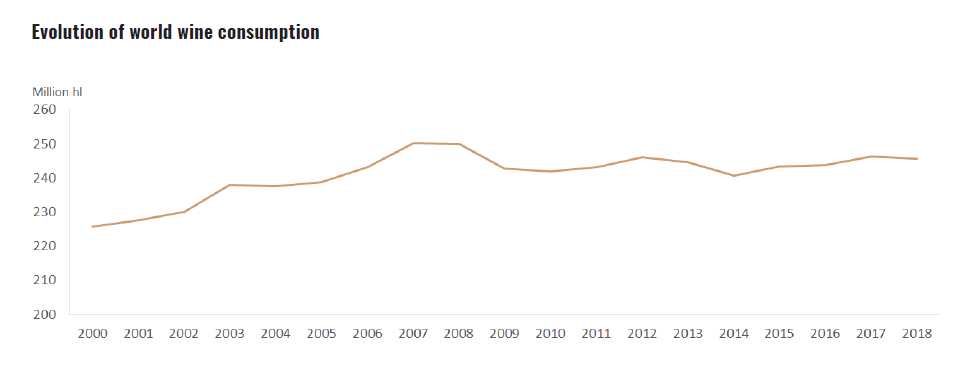
Though wine consumption worldwide has not reached pre-2008 recession levels, which categories of wine have gained in popularity/consumption (2)?
Rosé and sparkling wine consumption has increased significantly.
e.g. sparkling wine consumption has increased annually by an average of 3% between 2002-2018.
Describe the general trends of wine consumption over the last 2 decades for the following countries:
- USA
- France
- Italy
- Germany
- China
Generally, consumption levels have fallen or become “static” in traditional wine-drinking countries (France, Italy, Germany), while consumption in “non-traditional” countries has risen significantly.
USA: steady rise to over 30m hl in 2019, overtaking France as the world’s largest consumer by volume in 2011.
FRANCE: gradual decline from over 30m hl to ~25m hl.
ITALY: sharp decline until 2015, when consumption levels began to rise again.
GERMANY: remained static, ~20m hl.
CHINA: experienced rapid growth till 2013, eventually leveling out.
Identify some reasons behind the USA’s increased wine consumption from 2003-2019 :
USA’s increased wine consumption from 2003-2019 :
- Wine has increasingly become part of the mainstream culture, increased willingness to try new wine types.
- Globalization of the food and bev industries (growth of MNC’s increased availability of wine from different regions, countries).
- Increases and improvements in wine production domestically.
Identify some reasons behind CHINA’s increased wine consumption from 2003-2019 (2):
- Growing middle class, desire to show wealth and status by shifting from local drinks to wine.
- Desire to consume imported wines (at first, primarily French, but more recently Australian and Chilean wines: less expensive due to bilateral trade agreement).
Identify and explain different factors that have possibly led to declines in wine consumption (4):
Younger people drinking less wine: wine seen as old-fashioned; popularity of other drinks (e.g. gin in Spain); less time spent in bars/pubs due to more social media interaction.
Health concerns: increased awareness of alcohol’s negative effects on health, e.g. the “Loi Evin” in France, discouraging excessive drinking and depressing wine consumption.
Changes in lifestyle: busy lifestyles = shorter meals and less time spent drinking; tradition of drinking wine at lunchtime (prevalent in EU) disappearing as employers are forbidding the practice, or it being regarded as socially unacceptable.
Reduced availability of cheap wine: lower volumes of inexpensive, bulk wine being produced/sold/consumed, e.g. due to vine pull schemes intended to reduce over-production; drinkers switching to other, cheaper alcoholic/non-alcoholic drinks.
What are the main trends in terms of Changing Consumer Preferences?
Increased demand for :
- Rosé (esp. in USA)
- Sparkling wine : ex Prosecco sales (esp. UK / USA); expansion of Prosecco DOC boundaries in order to increase production and meet demand.
- Lower-alcohol wines (health concerns)
Decreased deman for :
- Sweet wines : ex Med. sweet German wines, e.g. Liebfraumilch (used to be popular in ‘50’s, 60’s, 70’s) = some brands have completely disappeared, while others, e.g. Blue Nun, have reinvented themselves in order to survive.
- Fortified wines (15-22% abv).
Explain how Changes In Reputation can affect wine consumption :
Reputation (region, producer, individual wine or grape) can fluctuate, leading to rises and falls of demand.
- Reviews from reputable publications / critics (e.g. Jancis Robinson in the UK, Wine Spectator in the USA) can encourage producers to raise their prices in subsequent vintages.
- Online influencers / Key Opinion Leaders (KOLs) can impact the desirability of specific wines/producers.
- Presence/exposure in pop culture, e.g. films, TV, music lyrics, celebrity endorsements, can increase exposure and popularity.
Explain how Changes In Spending Patterns have affected wine consumption habits :
The rise of ‘premiumization’; the willingness to spend more on individual bottles of wine because fewer bottles are being purchased.
Price-sensitive markets (Germany, UK) :
- Most consumers are unwilling to pay more than the lowest price possible for the desired style of wine.
- Fierce competition = lower prices for consumers, but fewer options as selling wine at this pricepoint would be unprofitable for many producers.
- Producers hope to build up ‘brand loyalty’ over time as part of marketing campaigns, thereby avoiding the problem of passing on production costs to the consumer.
Non Price-Sensitive Markets (France, USA) :
- Consumers are more willing to pay above the min. price for a wine they perceive to be higher in quality than the cheapest option.
What is a PRICE-SENSITIVE MARKET?
A market in which many consumers are unwilling to spend more than the lowest price possible for a certain product, regardless of affluence, e.g. Germany and the UK.
Explain how the Strength of the Economy can affect wine consumption habits :
Sales of wine will change with the level of consumer disposable income (i.e. the amount of money a person has after paying taxes)
Sales will :
- Decrease : When DI falls, as in a recession, wine consumers are likely to trade down to cheaper wines or switch to other, less expensive alcoholic drinks (e.g. beer or cider). For example, during the recession following the 2008 financial crash, demand for Champagne shrank whilst that for other, cheaper sparkling wines grew.
- Increase : When an economy is growing, such as has been seen in China, disposable income increases and consumers are often willing to buy more expensive wine. As explained above, the emerging middle-class in China has driven the increase in wine sales and demand for aspirational wines, such as those from Bordeaux and Burgundy, has increased.
Explain how Fluctuations in Currency Exchange can affect wine consumption habits :
Particularly significant in PRICE-SENSITIVE MARKETS.
If wine-exporting country’s currency strengthens :
- Exporting become more expensive :
- Producers may have to lower prices to remain competitive.
- Keeping the price stable will result in decrease of sales
- Importing become less expensive (barrels, corks, yeast …)
Alternatively, if wine-exporting country’s currency weakens :
- Exporting become less expensive.
- Keep price stable which would boost sales (e.g. 21st C. boom in Argentinian wine exports due to weak Peso.)
- Increase price to improve profits.
- Importing become more expensive
Explain how Changes to the Market can affect wine consumption habits (3):
- When products disappear from the market, this creates opportunities for competition.
e. g. if supply of Brand A Zinfandel decreases, demand for Brand B may increase. - Limited quantities also create the opportunity to raise prices (real/perceived scarcity).
- Introduction of a new, lower-priced or better value wine may eat into demand for other similar wines, causing producers to lower prices or search for alternative markets.
What are the three differents approach countries/states have in terms of regulating the sale of alcohol (Laws Prohibiting or Limiting the Sale of Alcohol) :
The sale of alcohol can be :
- Prohibited : in a number of countries, such as Indonesia and Iran
- Tightly-controlled : for example, through state-owned monopolies in countries such as Sweden, Norway and Canada, or, in the USA, the three-tier system. Any such controls inevitably limit the supply of wine and usually increase prices.
- Freely available : there is usually a minimum legal drinking age and sales of alcohol are generally limited to particular hours of the day.
Explain how Gov’t Policies to Reduce Alcohol Consumption can affect wine consumption habits:
Name 3 specific policies:
Many countries desire to reduce excessive alcohol consumption; illness, injuries, strain on health services, crimes caused by drunkenness.
Three famouse policies in order to achieve that :
- The “Loi Evin”; introduced by France in ‘91, restricted advertising of alcoholic drinks = significant reduction in wine consumption in France.
- “Minimum Unit Pricing”; introduced by Scotland to reduce availability of cheap alcohol, min. price of an alcoholic drink is GBP 0.50 = a 750ml bottle of wine (9 drinks) must be at least GBP 4.50 (previously could be GBP 3)
- Lowering the Blood Alcohol Concentration (BAC) limit for drivers in order to prevents accidents caused by drunk drivers:
Explain how Taxation can affect wine consumption habits (2):
Identify an example of both INCREASED and DECREASED consumption:
Gov’ts impose taxes and duty on alcoholic bevs, which can reduce consumption due to higher prices, but gov’ts also gain revenue from taxes. Therefore, it must be handled strategically.
Ireland : Major difference between tax on still (€3.19/bottle) and sparkling (€6.37/bottle) has greatly reduced the demand for the latter.
Hong Kong : Importation duty on wine abolished in 2008, intended to make HK the “wine trading hub” of East Asia. Caused a massive increase in auction sales of fine wine there.
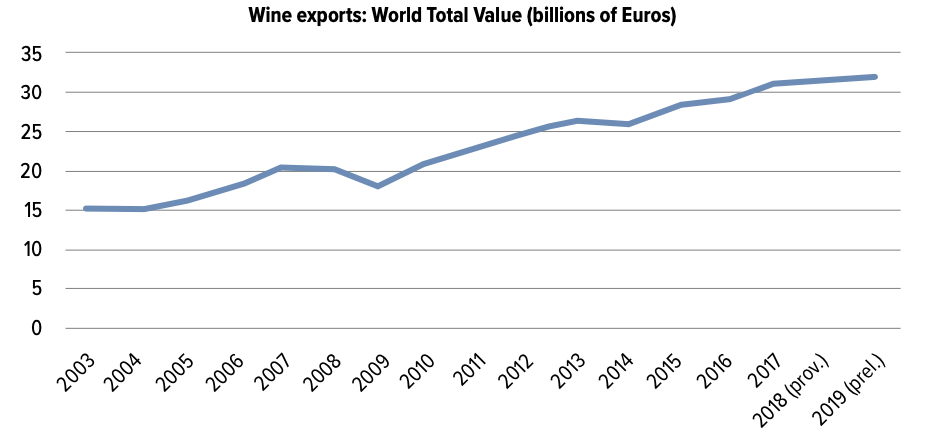
Describe the changes in global wine trade/exports since 2003 :
Global wine exports have more than doubled since 2003, from around €15 billion to over €30 billion, despite minor dips here and there, e.g. 2008 global recession.
Using the EU as an example, explain how trade agreements/relations can affect the price of wine :
- Customs duties are applied to imported goods, usually as a source of revenue for the gov’t, but sometimes as a form of protectionism, to encourage the consumption of local products.
- EU members enjoy tarrif-free trading between member states, meaning that products can be affordable even if imported from another country in the EU.
- Tariffs are still applied to products imported from most (e.g. Australia), but not all (e.g. South Africa/Chile), non-member states. This means that, within the EU, wines from S Africa and Chile enjoy a competitive edge price-wise over those from Australia.

-
1. Supply and Demand54
-
2. Factors that Affect the Price of a Bottle of Wine71
-
3. Types of Production Businesses31
-
4. Getting Wine to Point of Sale26
-
5. Wine Sales in the Retail Sector37
-
6. Wine Sales in the Hospitality Sector9
-
7. Monopolies and the Three-Tier System19
-
8. Introduction to Marketing17
-
9. Identifying the Product/Brand for Marketing33
-
10. Identifying the Target Market24
-
11. Setting Objectives of the Marketing Strategy2
-
12. Devising the Marketing Strategy40
-
13. Implementing/Monitoring the Strategy2
-
14. Marketing Options1
-
D2 Feedback Test12


